

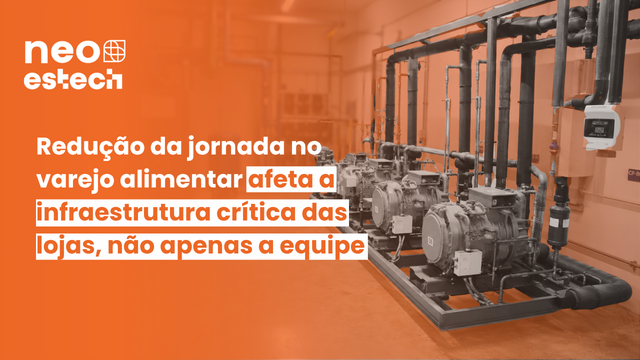
The reduction in working hours in supermarkets poses a direct risk: the monitoring of supermarket refrigeration ceases to be continuous when human supervision is reduced, yet cold stores and compressors continue to operate 24 hours a day. It is in this scenario that supermarket monitoring ceases to be a mere add-on and becomes critical infrastructure.
How does a supermarket’s operation change when working hours are reduced?
Supermarket operations are organised into two distinct tiers
The first is obvious: customer service, restocking and checkouts. It is directly linked to the presence of staff.
The second is critical yet invisible: commercial refrigeration, cold stores, compressors and air conditioning. This system does not stop running when the shop closes.
With shorter working hours, three effects occur simultaneously:
- Reduction in human presence in critical infrastructure sectors.
- Extension of the period without inspection from ~10 hours at present to up to 34 hours, depending on the format adopted.
- Greater reliance on automated systems monitoring and control.
What is the actual risk of an unmonitored cold store?
Perishable food enters the danger zone in less than 4 hours without proper temperature control.
With a window of 14 to 34 hours without an on-site inspection, a commercial refrigeration fault may pass the point of no return before it is detected. As a result, the problem is not the fault itself, but the time taken to detect it.
In the Brazilian food retail sector, around 10 per cent of operating losses are linked to faults in refrigeration equipment, which are currently still kept under control through frequent physical inspections. (Source: ABRAS / Working Hours Survey — NEO ESTECH, 2025)
In a sector with a net margin of 2% of revenue, any increase in the time taken to detect a fault has a direct impact on reducing losses in the food retail sector.
Does closing the shop reduce energy costs? Not in the way you might think
This is one of the most dangerous oversimplifications in the debate on reduced working hours.
In a typical supermarket (~1,200 m²), Refrigeration accounts for around 60 per cent of total electricity consumption. It therefore operates 24 hours a day, regardless of opening hours. HVAC and lighting vary according to the time of day. Cooling does not.
In practice, a change that reduces opening hours by 9 per cent could generate around 6% total saving approximately R$ 36,000 per shop per year at a local supermarket and R$ 108,000 in wholesale retail. (Source: NEO ESTECH, 2025)
However, this saving can only be achieved through active technical control. Without refrigeration monitoring in supermarkets, the projected saving does not show up on the bill, and a silent breakdown in the early hours of the morning can wipe out months of profits.
What is a refrigeration monitoring system for supermarkets?
In practice, a refrigeration monitoring system for supermarkets operates on four levels:
- Real-time sensing: Temperature, energy and pressure in commercial refrigeration equipment;
- Deviation analytics: Identifying anomalies before a failure occurs, thereby reducing losses in the food retail sector;
- Structured decision: Automatic prioritisation of tickets based on business impact;
- Data-driven action: Alert-based response, eliminating the need for manual patrols.
Today, it is estimated that only ~10% of shops in Brazil They specialise in structured commercial refrigeration automation. (Source: Working Hours Survey — NEO ESTECH, 2025)
Why does the sector’s P&L leave no room for operational errors?
The food retail sector operates on margins that leave very little room for inefficiency.
The typical breakdown of a Brazilian supermarket’s profits shows just how much the sector is already operating at its limits:
- Cost of goods sold (COGS): 73.7% of revenue
- Operating costs (SG&A): 21.7% of revenue
- Operating losses: 1.87% of revenue (Source: ABRAS / KPMG–Abrappe, 2024)
- Net margin: ~2%
In view of this, any increase in wastage of perishable goods, incident response times or compliance failures directly impacts the business’s bottom line. That is why the supermarket monitoring Real-time processing is no longer a competitive advantage but has become an operational requirement.
Why doesn’t adjusting shifts solve the problem?
Redeploying staff and reviewing contracts addresses the visible aspects of the operation. However, critical infrastructure – commercial refrigeration, power supply and cold stores – remains vulnerable.
The necessary transition is from a model based on attendance and inspection for a model based on software for continuous monitoring and data-driven decision-making.
As a result, companies that fail to make this change tend to operate with a higher risk of losses on perishable goods, less predictability regarding compliance, and increasing pressure on their margins.
👉 Try NEO and see how you can turn data into real operational control. Click here!


 Portuguese (Brazil)
  Portuguese (Portugal)
  Spanish
  English
  French